blake marques carrington
discography:


 vimeo highlights:


 contact
bio
contact
bio


blake marques carrington
discography:
vimeo highlights:
contact
bio

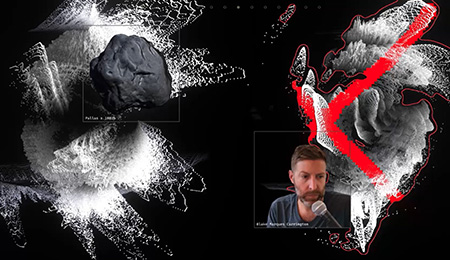
056 How to Get Ahead in the Interstellarized Economy / 2026
“How to Get Ahead in the Interstellarized Economy”
Blake Marques Carrington
2026
Single-channel video, stereo sound
Running time 6:50
In the near future, humanity is invaded by a superintelligent species from outside the solar system — sentient asteroids. They seem nice enough. To make themselves useful in the new economy, some humans have begun the frustrating task of learning the language of our masters. This is a documentation of one such lesson, conducted between an Asteroidean cultural exchange ambassador and Earth-based artist Blake Marques Carrington.
Background
The conceptual seeds for this piece were planted shortly after the release of the first wave of mainstream generative A.I. tools in 2022. After a brief period of wonder, I quickly got bored with a creative process that allows artists’ input only in the form of text prompts. I felt locked out of the place where magic happens — why would I want to outsource that part of my imagination? Then in 2023 at a lecture given by a mathematician, I learned about a specific algorithm that was at the heart of most machine learning systems. Called “gradient descent” and first developed in 1847, it seemed like it could be a key to unlock the black box and play with all the messy bits inside. After several experiments probing the engineering side of the question, in this piece I come back to the thread embracing the humanities side, in a role informed by my experiences as a language learner and teacher.
Material Conditions
Lithic computation is a term for a cheeky idea found online in various formats: a computer is simply a rock that we tricked into thinking by zapping with electricity. The idea grounds digital technology in its material conditions, countering the airy descriptions of “the cloud” made by tech zealots. In this piece, however, the material focus is less about what makes this rock’s sentience possible, and more about the socioeconomic effects on humans of the new order. The interstellar economy is now dominated by the Asteroideans. What opportunities are left for Earth natives? “How to Get Ahead in the Interstellarized Economy” is a speculative narrative that reveals its implied answer to be: learn the language of the ruling class, if you can.
Speculative Forensics
That task proves to be impossible. The premise, however, allows a dive into an idea I’ve used consistently in works over the past 10+ years. Speculative Forensics is a conceptual thread that unifies much of my work, examining the ways that symbolic systems are encoded and decoded. The act of unpacking information from an encoded bit is at the heart of Speculative Forensics. Relating this idea to the specifics of linguistic systems as depicted in the present work, we can consider a few levels of barriers that prevent us from unpacking and gaining inside access to those systems, i.e. gaining fluency.
Barriers to Access
A level one barrier, common to most people that have attempted to speak a foreign language, is the difficulty of pronouncing sounds that aren’t present in one’s native language. This barrier is why we find it so hard to overcome our native accent, even when achieving fluency. As members of the human species, we all have the same basic hardware — lungs, vocal cords, tongue, mouth, lips — with which we can theoretically produce any phoneme from any human language. We’ve just been imprinted with different software by our native cultures which enables and restricts us to programming our hardware in a specific way.
A level two barrier crosses into interspecies communication, and addresses the difficulty of producing sounds not present in any human language. One example of efforts in this direction is the commendable Project CETI (Cetacean Translation Initiative), which attempts to map and decode the languages of whales for the purpose of elevating human awareness of cetaceans as entities worthy of recognition. Franz Fanon, in Black Skin, White Masks (1952) said “to speak is to exist absolutely for the other”. He was speaking and writing in French, as an Algerian-Caribbean man navigating white French society. Perhaps we can apply Fanon’s postcolonial analysis also in a posthumanist manner, by considering how a non-human species may be “elevated” to a status of personhood based on its ability to communicate with humans. In the case of Project CETI, given that cetaceans lack the hardware needed to vocalize human language, we have crossed the barrier ourselves with technology in the effort to understand them. As of now, that communication is one-way, with efforts by humans to learn and speak in whale language still existing only in science fiction.
In a different case exploring the level two barrier, we can consider AIC (Augmentative Interspecies Communication). AIC allows dogs to speak in human language by pressing buttons loaded with pre-recorded phrases. With dogs’ clear ability to understand a range of words and phrases spoken by their owner, this research opens up a pathway for more profound two-way communication aided by technology.
A level three barrier is the impossibility of humans to insert themselves anywhere in the communication path —whether in vocalization, perception, or cognition. We may not have the necessary hardware built into our bodies for native cetacean communication, but whales speak by propagating sound waves, which the recipient then perceives via structures similar to human ears as well as via tactile vibrations of the body. This is a communication path that we, as fellow mammals, can viscerally perceive, if not decode. However, as artist Trevor Paglen’s inspiring work on machine-to-machine image-making explores, our communications landscape is rapidly filling with signals created by A.I. agents for other A.I. agents, with no human presence in the loop. The optimized training of new models incentivizes this removal of humans from the process, as evidenced a decade ago by Google’s DeepMind A.I. program called AlphaGo. The board game Go, invented in ancient China and popularized for the west via Japan, exceeds the complexity of chess by many orders of magnitude. The total possible states of the 19╳19 board amount to around 10170, which is more than double the amount of atoms in the entire observable universe. Surprising even the researchers close to the project, in 2016 AlphaGo beat the human Go grandmaster Lee Sedol in a 5-match series, 4 to 1. AlphaGo was able to do this because it transcended the need for human input in its training. At first, it learned the game by studying every human match ever recorded in history. The transcendent leap occurred when it took that base knowledge of every historical move, and then played millions of games against a different instance of itself. It was no longer bound by history, habit or tradition, a fact shown by move #37 in game two. This particular move was so strange that Lee Sedol had to take a 15-minute break to consider what AlphaGo’s strategy could possibly be. Human comprehension had been made obsolete.
Returning to the topic of the present work’s title — if humans are irrelevant to the success of our future goals, what could our role possibly be? The anxiety of “getting ahead” is parodied to comedic effect, but is a ubiquitous mental health issue in reality. Only a radical transformation of our future goals will suffice to save us.
Notes on Sound Design Process
The sound design of the Asteroidean vocalizations was achieved via a variety of tools, both A.I.-based and traditional. The workflow began with the VCTK (Voice Cloning Toolkit) model, which is a corpus trained on 44 hours of speech data from 109 English speakers, developed at the University of Edinburgh’s Center for Speech Technology. This model takes live audio input, maps it in a weighted process to the data it was trained on, and spits out a mess of sounds that ostensibly explore the latent space of potential provided by the collision of training data and input data. An inspiring example of how this works can be found in the seminal series by Memo Akten “Learning to See” (2017 - ), in which he shows that A.I. models, and by extension humans also, can only see what they’ve been trained to see. A model trained on images of the ocean receives as input an image of a crumpled up dish towel, and in a poignant error of interpretation it generates an image of roiling ocean waves.
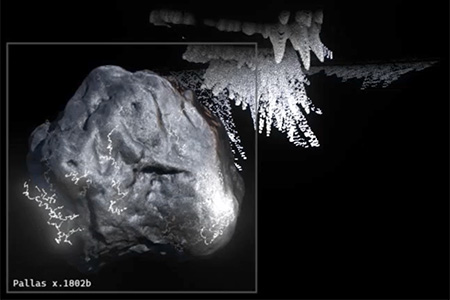
My audio input to the VCTK model was a reading of various phonetic pangrams — phrases that contain all phonemes of the English language. After recording long stretches of outputs from the model, I cut parts down to short clips that most resembled something with the cadence and tonal qualities of what I thought a rock speaking should sound like, then had a few more rounds of processing and fx to shape and fine-tune the sounds. The farce of generative A.I. today is really that it’s not artificial at all — it requires the intelligence and labor of humans to build the models. Pallas x.1802b is really a twisted agglomeration of my voice plus the 109 people in the VCTK corpus.
056 How to Get Ahead in the Interstellarized Economy
055 An Ambivalent Path to Everywhere
054 Memory of Gravity Past
053 Study on Reflections (Delayed But Not Forgotten)
052 Black Box Drawings
051 Create New Formations (Facade version)
050 Study on the Metaphysical Status of a Table
049 An Infinite Density Over Zero
048 Computational Landscape Series
047 Seismoglyph (Mitosis version)
046 Artbook Trilogy
045 Plasmatic FK
044 Bonsai-Gan
043 The Albers Variations
042 A Mess That Encodes
041 An Extended Bootleg
040 A Scattered Bootleg
039 TYWMC at FILE Festival São Paulo
038 TYWMC at Mapbox Locate
037 An Infinite Distance Between Two Points
036 The End of Information
035 Patti Smith Italy Tour
034 Strata Systems v02_NIJIMI
033 Killer Road
032 The Year We Make Contact
031 Bessarabia Ghost Tapes
030 Strata Systems v01_LOCI
029 Performance at The Icebox for Shaping a Signal
028 A Strong Hand That Nonetheless Gets You Nowhere
027 Apple Blossom Time
026 Loci_Convergence
025 Noisebed
024 Loci_Palimpsest
023 The Ornithologist Ghosthunter
022 Erosion/Evaporation (Scan Reina Sofia)
020 Haeinsa_Palimpsest
018 High and Low (Sightlines)
017 Dis/continuum
016 Cathedral Scan
015 Suomenlinna Ornithological Society
014 Loci_
012 Topoextension
011 ATS02: Solve
007 ATS01: Wisp
005 Moby the Mobile Projection Unit
004 Avalanche at Broad Street


